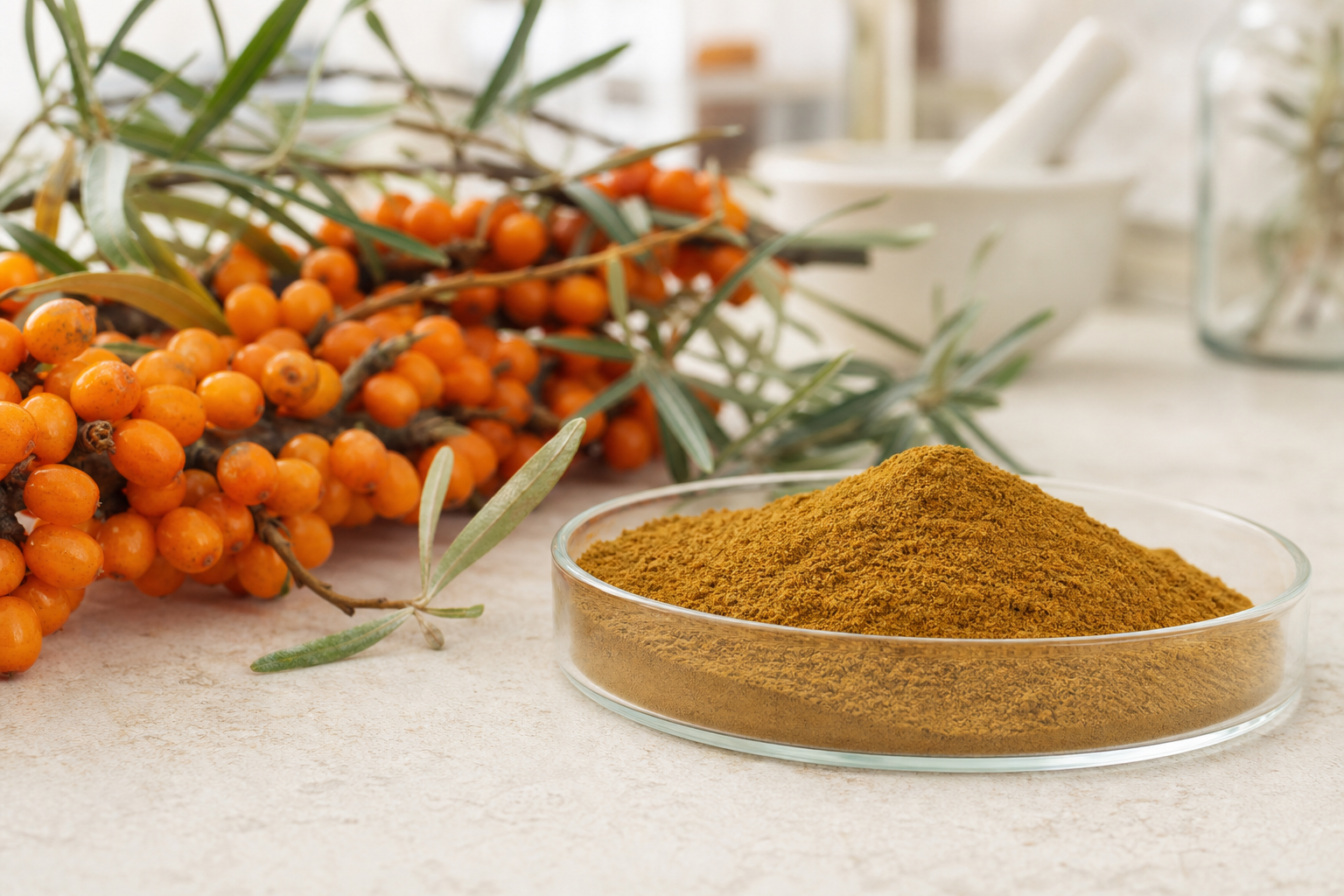
Sea buckthorn extract powder is a concentrated botanical ingredient derived from Hippophae rhamnoides. For supplement, functional food and personal-care projects, its commercial value depends on much more than the name printed on a quotation. Plant part, extraction process, extract ratio or marker specification, carrier system, contaminant limits and application performance can all affect whether a material is suitable for a finished formulation.
This guide explains how sea buckthorn extract differs from sea buckthorn fruit powder and sea buckthorn oil, which specifications a professional buyer should confirm, and what documentation to review before approving a sample or bulk order.
Important distinction: This page discusses sea buckthorn extract powder, not a simple dried fruit powder. It also does not assume that an extract powder is standardized for Omega-7. Omega-7 is a fatty-acid specification most commonly associated with sea buckthorn pulp oil and must be supported by an appropriate analytical method when claimed.
Sea Buckthorn Extract Powder at a Glance
Botanical source: Hippophae rhamnoides L.
Ingredient type: Concentrated botanical extract supplied in powder form
Common commercial uses: Capsules, tablets, powder blends, gummies, stick packs, selected beverage systems and selected cosmetic formulations
Specification basis: Extract ratio, one or more agreed marker compounds, or a buyer-defined analytical profile
Key purchasing checks: Plant part, extraction solvent, carrier, identity method, assay or extract ratio, physical properties, contaminant limits and batch documentation
Key formulation checks: Color, flavor, hygroscopicity, dispersibility, sedimentation, pH response and heat stability
The expression “sea buckthorn extract” is not a complete specification. Buyers should treat it as the beginning of a technical discussion rather than as proof that two suppliers are offering equivalent materials.
What Is Sea Buckthorn Extract Powder?
Sea buckthorn extract powder is produced by extracting selected constituents from an identified sea buckthorn raw material, concentrating the resulting liquid and drying it into a powder. The precise process may vary according to the intended composition and application. A commercial extract may be defined by an extract ratio, by an agreed marker such as total flavonoids, or by a broader analytical fingerprint.
This is different from milling or spray-drying the fruit into a general fruit powder. A fruit powder primarily represents dried fruit solids. An extract is manufactured to concentrate or control selected soluble constituents. The difference affects ingredient identity, use level, sensory impact, testing requirements and label description.
The term also should not be used interchangeably with sea buckthorn oil. Oil products are lipophilic fractions obtained from the pulp, peel, seeds or whole berry. Their relevant specifications include fatty-acid composition, oxidation indices and oil-source identification. Those measurements do not automatically describe a botanical extract powder.
Sea Buckthorn Extract vs. Fruit Powder vs. Oil
| Ingredient form | How it is generally defined | Main specification focus | Typical application considerations |
| Sea buckthorn extract powder | A concentrated botanical extract dried into powder form | Plant part, extraction process, extract ratio or markers, carrier, identity, moisture, contaminants and dispersibility | Potency target, powder flow, color, taste, compatibility and validated use level |
| Sea buckthorn fruit powder | Dried or spray-dried fruit material containing broader fruit solids | Fruit content, carrier, moisture, particle size, color, flavor and microbiology | Higher sensory contribution, acidity, bulk and possible sedimentation |
| Sea buckthorn pulp oil | Lipid fraction obtained primarily from the fruit pulp or peel | Fatty-acid profile, including palmitoleic acid where relevant; peroxide value; anisidine value; carotenoids and identity | Oil-based capsules, emulsions and topical systems; oxidation and light protection |
| Sea buckthorn seed oil | Lipid fraction obtained from the seeds | Fatty-acid profile, commonly emphasizing linoleic and alpha-linolenic acids; oxidation and identity | Oil-based products requiring control of oxidation, packaging and source |
Scientific reviews consistently describe meaningful differences between pulp and seed oils. Pulp oil is typically the fraction more closely associated with palmitoleic acid, an Omega-7 fatty acid, whereas seed oil is generally richer in Omega-3 and Omega-6 fatty acids. This distinction is important, but it should not be extended to a sea buckthorn extract powder without product-specific evidence.
If Omega-7 content is commercially important to a project, the buyer should request the exact ingredient form, the tested fatty-acid profile, the analytical method and a batch-specific result. A generic reference to sea buckthorn is not sufficient.
Key Specifications for B2B Buyers
1. Botanical identity and plant part
The specification should state the accepted botanical name and identify the plant part used. Fruit, pulp, peel, seed and mixed raw materials can produce materially different chemical profiles. Identity may be supported through a combination of supply-chain records, macroscopic or microscopic examination, chromatographic fingerprinting and other suitable botanical identification methods.
2. Extract ratio or marker specification
An extract ratio such as 10:1 describes a manufacturing relationship, but it does not by itself prove the concentration of a particular constituent. The buyer should understand how the ratio is calculated and whether carriers or processing aids are present.
Where a marker-controlled extract is required, the specification should identify the marker, target or acceptance range, test method and reporting basis. Depending on the material and project, relevant analytical targets may include total flavonoids, selected flavonoids, polyphenols or another agreed fingerprint. The appropriate choice should be based on the actual extract and intended formulation rather than on a generic market claim.
3. Extraction solvent and process
The extraction solvent influences which constituents are recovered. Water, ethanol-water systems and other permitted solvents can produce different profiles. Buyers should confirm the solvent system, residual-solvent limits and whether the process is compatible with their destination market and label requirements.
Process descriptions should remain specific and verifiable. Terms such as “advanced extraction” or “maximum bioavailability” are not useful procurement specifications unless they are supported by defined process controls and comparative evidence.
4. Carrier and excipient disclosure
Some extracts require a carrier to support drying, stability, flow or dispersibility. The carrier type and percentage can affect label declarations, allergen review, active concentration, sensory performance and cost comparison. A quotation based only on price per kilogram can therefore be misleading when two products contain different amounts of carrier.
5. Physical properties
Appearance, odor, taste, particle size, moisture, ash and bulk density help predict how the extract will behave during handling and manufacturing. Natural botanical variation may influence color and sensory profile, but an approved reference sample and reasonable acceptance criteria can help control batch-to-batch differences.
Do not assume that a standard extract powder is fully water-soluble. “Soluble,” “dispersible” and “suspendable” describe different behaviors. The required test should reflect the finished application, including water temperature, pH, mixing conditions and observation time.
6. Purity and contaminant limits
A fit-for-purpose specification should address microbiological quality, heavy metals, pesticide residues and residual solvents. Depending on the raw-material history, processing method and destination market, buyers may also request mycotoxins, polycyclic aromatic hydrocarbons, irradiation status or other risk-based tests.
Limits should be agreed in advance. “Complies” is meaningful only when the specification, analytical method and applicable regulatory or customer standard are clear.
Applications and Formulation Considerations
Capsules and tablets
Extract powder is often suitable for capsules and tablets, but extract ratio alone does not determine the correct use level. Formulators should consider the marker target, serving size, bulk density, flow, compressibility and interaction with other ingredients. Pilot testing should assess fill-weight consistency, tablet hardness, friability, disintegration and color transfer.
Gummies
Sea buckthorn extract may contribute an orange-brown color and a tart or astringent botanical note. The behavior of the extract should be evaluated under the formulation’s pH, temperature and water-activity conditions. Marker stability, color drift, flavor balance and interaction with the gelling system should be assessed during pilot production.
Beverage powders and stick packs
For dry beverage systems, confirm dispersibility, sedimentation, flavor impact, hygroscopicity and package protection. A powder that performs acceptably in room-temperature water may behave differently in acidic, mineral-rich or protein-containing systems. Clear beverages require particular caution because a botanical extract may create haze or sediment.
Functional foods
Bars, nutrition blends and powdered foods may offer more tolerance for natural color and flavor than clear beverages. Even so, formulators should test heat exposure, water activity, oxidation, mineral interactions and uniform distribution. Processing conditions should be reviewed against the marker or fingerprint used to define the ingredient.
Cosmetic and personal-care formulations
For cosmetic use, confirm the intended regulatory status, solvent compatibility, color contribution, odor, pH tolerance and microbial strategy. A powder extract intended for an aqueous phase is not technically equivalent to sea buckthorn oil. INCI naming and documentation should be reviewed for the actual material and target market.
Quality Testing and Documentation
Before approving a sea buckthorn extract supplier, buyers should request documents that correspond to the actual grade and batch under evaluation.
Core technical documents
Product specification
Technical Data Sheet (TDS)
Batch-specific Certificate of Analysis (COA)
Safety Data Sheet (SDS), where applicable
Manufacturing-flow summary or process declaration
Storage condition and shelf-life statement
Quality and compliance documents
Botanical identity and plant-part information
Allergen statement
GMO statement
Irradiation statement
Country-of-origin or traceability information
Microbiology and heavy-metal results
Pesticide and residual-solvent data appropriate to the project
Relevant certification documents, with scope and validity confirmed
A certificate logo on a website does not establish that every product is covered. Buyers should confirm the legal entity, certified site, certification scope, expiration date and applicability to the specific sea buckthorn extract.
How to Evaluate a Bulk Sea Buckthorn Extract Supplier
Confirm that the offered material matches the project
Start with the intended dosage form, target market and technical objective. A supplier should be able to explain the plant part, extract definition, carrier, assay or ratio, and the tests used for batch release.
Compare specifications, not product names
Two materials called “sea buckthorn extract powder” may differ in composition and performance. Compare the complete specification, COA, carrier content and application behavior before comparing price.
Evaluate batch consistency
Ask how the supplier controls raw-material identity, color, odor, moisture, marker level and contaminants between batches. Retained samples, approved reference samples and trend data can support repeat-order consistency.
Link the sample to commercial supply
Confirm that the sample is representative of the intended bulk grade. Record the sample lot, specification revision and analytical results so the commercial batch can be compared against the material used during formulation.
Review change-control practices
Changes to plant source, extraction solvent, carrier, manufacturing site or test method may affect a formulation or regulatory file. Buyers should understand how material changes are communicated and approved.
Assess export and technical support
For international projects, document preparation, packaging suitability, labeling, route conditions and response time can be as important as manufacturing capacity. The requested documents and destination-market requirements should be agreed before ordering.
Scientific Evidence and Responsible Product Positioning
Sea buckthorn contains diverse phytochemicals, including flavonoids, phenolic compounds, carotenoids and other constituents. Their distribution varies by cultivar, plant part, geography, harvest conditions and processing method. Published research has investigated fruit, juice, extracts, seed oil and pulp oil, but these materials should not be treated as interchangeable.
For ingredient marketing, evidence should be matched to the tested material. An oil study cannot automatically substantiate a powder-extract claim, and an in-vitro result does not establish a clinical outcome. Statements such as “has been studied for” or “contains compounds associated with” can help preserve scientific context, but they still require an appropriate source.
Final product claims also depend on dosage, formulation, jurisdiction and the quality of the supporting evidence. Manufacturers should complete their own regulatory and claims review for each destination market. This sourcing guide is not a substitute for legal, regulatory or clinical advice.
Practical Takeaways for Sourcing Teams
For most projects, the best starting point is not a request for the “highest-quality” or “best” sea buckthorn extract. Those terms are too broad to support a technical comparison. A more useful approach is to define the application, target composition, acceptable carrier, destination-market limits and required documentation before reviewing samples.
The central lesson is simple: compare the identity and specification behind the product name. Confirm that the material is an extract rather than a fruit powder, avoid transferring oil-related Omega-7 claims to an extract without analytical evidence, and test the proposed grade under the conditions of the finished formulation.
Green Life Herb prepared this guide to help ingredient buyers and product developers structure that evaluation. Any project-specific availability, specification, certification, packaging or lead-time information should be confirmed separately rather than inferred from this educational article.
Continue the Ingredient Discussion
If your team is evaluating sea buckthorn extract powder, Green Life Herb can discuss the technical questions that should be considered for your intended application. Product-specific supply details should be verified during that separate project review. Contact us at sales16@gl-herb.com.
References
Ma Q-G, et al. Hippophae rhamnoides L.: A Comprehensive Review on the Botany, Traditional Uses, Phytonutrients, Health Benefits, Quality Markers, and Applications. Journal of Agricultural and Food Chemistry. 2023;71(12):4769-4788. https://pubmed.ncbi.nlm.nih.gov/36930583/
Zielinska A, Nowak I. Abundance of active ingredients in sea-buckthorn oil. Lipids in Health and Disease. 2017;16:95. https://pmc.ncbi.nlm.nih.gov/articles/PMC5438513/
Solcan C, et al. The impact of sea buckthorn oil fatty acids on human health. Lipids in Health and Disease. 2019;18:145. https://pmc.ncbi.nlm.nih.gov/articles/PMC6589177/
Criste A, et al. Sea Buckthorn in Plant Based Diets. An Analytical Approach of Sea Buckthorn Fruits Composition: Nutritional Value, Applications, and Health Benefits. International Journal of Environmental Research and Public Health. 2021;18(17):8986. https://pmc.ncbi.nlm.nih.gov/articles/PMC8431556/
Ma X, et al. Sea Buckthorn Pretreatment, Drying, and Processing of High-Quality Products: Current Status and Trends. Foods. 2023;12(23):4244. https://pmc.ncbi.nlm.nih.gov/articles/PMC10706557/
Looking for Premium Plant Extracts?
Green Life Herb supplies 280+ botanical extracts with ISO/HALAL/Kosher certifications.
Custom specifications and sample orders available.