“For dietary supplement, functional food and beverage teams evaluating green coffee ingredients for weight-management concepts.”
Interest in chlorogenic acid for weight loss has made green coffee one of the most searched botanical ingredient categories in the weight-management market. But for B2B teams, the useful question is more specific than “does it work?”
What does the human evidence actually show? Which green coffee bean extract was studied? How much chlorogenic acid and caffeine did it contain? And can the ingredient being sourced be meaningfully compared with that material?
The available research warrants a measured answer. Green coffee extracts and chlorogenic acids have been studied in relation to body weight, but the human evidence remains limited, the products studied are not identical, and study quality varies. This does not support presenting chlorogenic acid powder as a standalone or guaranteed weight-loss solution. It does support a more rigorous conversation about ingredient identity, standardisation, caffeine control and batch documentation.
This guide explains how procurement, formulation and brand teams can interpret the evidence and qualify a green coffee chlorogenic acid ingredient responsibly.
What is chlorogenic acid in green coffee bean extract?
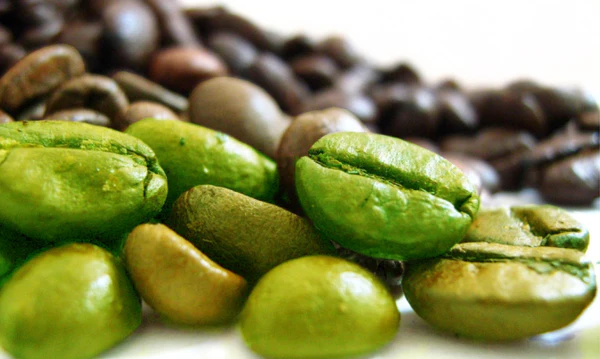
Green coffee beans are coffee seeds before roasting. A green coffee bean extract is a botanical preparation derived from that material. It can contain a family of chlorogenic acids (CGAs), alongside other naturally occurring constituents; caffeine can also be present.
That distinction matters commercially. “Chlorogenic acid powder,” “green coffee extract,” and “green coffee chlorogenic acid” are often used loosely in search and sales copy, but they are not automatically interchangeable specifications. A buyer needs to know whether an offer is:
- a standardised green coffee bean extract;
- an extract specified for total chlorogenic acids;
- a material defined around one or more CGA isomers; or
- a higher-purity chlorogenic acid material.
For a formula developer, the percentage on a quotation is only the beginning. A complete specification should also define the botanical source and plant part, the CGA reporting basis and analytical method, caffeine level, carrier if used, moisture, particle size, physical appearance, packaging, storage and shelf life.
This is especially important for a weight-management concept. A high-CGA statement does not describe stimulant exposure, formula compatibility or the quality of the clinical evidence behind the material.
What does research say about chlorogenic acid for weight loss?
The short answer is that there are human studies and meta-analyses suggesting a possible weight-related effect, but the evidence is not strong enough to justify broad, outcome-guaranteeing claims.
The U.S. National Institutes of Health Office of Dietary Supplements (NIH ODS) notes that only a small number of human clinical trials have evaluated green coffee bean extract for weight loss and that the trials it assessed were of poor methodological quality. Its professional fact sheet describes a possible modest effect on body weight, while also highlighting the evidence limitations and the fact that green coffee contains caffeine.[1]
A 2023 systematic review and meta-analysis pooled three randomised controlled trials with 103 participants and reported a directionally favourable change in body weight for green bean coffee extract containing at least 500 mg/day of CGA. The authors also stated that the evidence was based on a limited sample and short-term studies, and called for more long-term research on efficacy and safety.[2]
Earlier evidence reached a similarly cautious place. A 2011 review found a statistical signal in a small number of green coffee extract trials, but noted substantial methodological limitations in the studies it included.[3] In other words, a numerical result from one review should never be treated as a universal expected outcome for every green coffee extract—or for every person who consumes it.
Why study design changes the interpretation?
When reviewing weight-management literature, teams should check more than the headline outcome. Important questions include:
- Was the intervention a green coffee bean extract, a specific chlorogenic acid composition, or a multi-ingredient product?
- What was the botanical source, CGA profile and caffeine content?
- How much material was used, for how long, and in which population?
- Was the study randomised, blinded and placebo-controlled?
- Did it measure body weight directly, or only a short-term metabolic marker?
- Were diet, exercise and other potentially confounding variables assessed?
These details are not academic fine print. They determine whether a study is relevant to a finished product or ingredient programme. FDA guidance on dietary-supplement claim substantiation makes the same point: the evidence should relate to the specific product or ingredient, the serving size, conditions of use, target population and outcome claimed. FDA gives “promotes weight loss” as an example of a claim that would likely not be adequately supported by a study showing only a short-term metabolic change without a measured weight outcome.[4]
For this reason, it is more accurate to say that green coffee extract has been studied in relation to weight management than to say that chlorogenic acid powder “causes weight loss.”
A mechanism is not a finished-product claim
Scientific discussions often explore pathways related to carbohydrate handling, lipid metabolism or energy balance. Those discussions can be useful background for R&D. They are not, on their own, evidence that an orally consumed ingredient will produce meaningful weight loss in a real-world population.
Animal, cell and mechanistic findings may help explain why an ingredient is being investigated. They cannot replace well-designed human outcome studies. FDA guidance similarly cautions that in vitro and animal evidence alone is insufficient to substantiate an effect in people.[4]
Why CGA percentage alone does not establish a weight-management benefit
The phrase “50% chlorogenic acids” can be useful for standardisation. It is not a clinical conclusion.
Research on green coffee has used materials that differ in CGA composition, caffeine level, dose, duration and delivery format. Some research has evaluated named or proprietary ingredients rather than generic green coffee bean extract. Results from those materials cannot automatically be assigned to another branded ingredient solely because both contain chlorogenic acids.
This is a critical point for brands using green coffee bean chlorogenic acid in a supplement, drink powder or functional food. Before drawing on published research, compare the study material with the proposed ingredient across the following criteria:
| Comparison point | Questions for the buyer or formulator |
|---|---|
| Botanical identity | Was the same Coffea source and plant part used? |
| CGA definition | Does the study report total CGAs, specific isomers, or a different assay basis? |
| Caffeine profile | Is caffeine comparable, controlled or materially different? |
| Dose and format | Is the ingredient amount and delivery format comparable to the proposed finished product? |
| Study population | Does the population resemble the intended consumer group? |
| Formula context | Were other active ingredients present that could influence the result? |
| Evidence quality | Was the trial appropriately designed to measure the outcome that is being discussed? |
If those points do not align, the publication may still be useful as general green coffee research context. It should not be presented as clinical evidence for the new ingredient or finished product.
Caffeine belongs in the specification—not in the footnotes
Because green coffee materials can contain caffeine, an effective procurement brief should specify both the CGA target and the caffeine requirement. This is essential when the finished formula also includes tea extracts, guarana, caffeine anhydrous or other stimulant sources.
NIH ODS notes that caffeine in green coffee beans can cause problems at high doses or when combined with other stimulants.[1] The appropriate finished-product safety assessment depends on the formula, serving size, intended consumer, target market and applicable rules. The supplier’s role is to provide a clear, accurate caffeine specification and lot-level evidence where applicable; the brand’s role is to assess the total formula and final market positioning.
Avoid describing an ingredient as “caffeine-free” unless the actual grade, analytical method and specification support that statement. Likewise, “low caffeine” should always be tied to a defined limit rather than used as a vague marketing phrase.
How to qualify a green coffee chlorogenic acid powder for a B2B project
For procurement teams, responsible weight-management positioning starts with a comparable, documented ingredient—not a dramatic headline. Use a qualification workflow that connects scientific context to the material you will actually buy.
1. Define the technical brief
Before requesting a sample, set out:
- destination market and finished-product category;
- target CGA level and how it should be reported;
- caffeine limit and test expectation;
- intended format, such as capsule, tablet, powder blend or beverage;
- physical requirements, including particle size, solubility/dispersibility and carrier acceptance;
- annual volume, first-order volume and required documentation.
2. Review the product identity and test method
Ask for the product specification or technical data sheet (TDS), safety data sheet (SDS), and a representative batch Certificate of Analysis (COA). The COA should identify the lot and show actual results against specifications. Confirm how CGA and caffeine are measured; if HPLC information or a chromatogram is available for the relevant grade, it can help technical teams discuss analytical identity and reporting.
3. Check the data that affects formulation fit
Alongside assay results, review moisture, particle size, appearance, carrier declaration, packaging and storage. Depending on the raw material, process and destination market, buyers may also need information on heavy metals, microbiology, pesticide residues or residual solvents.
4. Match sample approval to first-lot approval
A passing sample is not the same as a qualified supply programme. When the first commercial lot is ready, compare the shipment lot number, COA, manufacture date, specification and actual results with the approved sample and purchase requirements. Establish a process for later review of batch trends and material changes.
This approach helps ensure that the green coffee extract used in a formulation is the material that was assessed—not just a similarly named powder.
SoluxBean®: a documented green coffee ingredient platform
SoluxBean® is Green Life Herb’s branded green-coffee-derived chlorogenic acid powder platform for B2B ingredient evaluation. It is intended to help brands begin with a documented specification rather than a generic weight-loss promise.
For a SoluxBean® sourcing discussion, share the intended destination market, target CGA level, caffeine requirement, application format and required document list. Green Life Herb can then review the applicable grade and provide the relevant product specification and representative batch documentation for supplier-qualification evaluation.
This is the right place to evaluate a green coffee ingredient for a weight-management concept: through raw-material identity, assay definition, caffeine control, physical fit and batch records. It is not appropriate to describe SoluxBean® as clinically proven for weight loss unless Green Life Herb has completed and can substantiate research on the same grade, dose and intended use.
Responsible global marketing: language that supports trust
For brands selling into the United States and Europe, wording should reflect the totality of the evidence and the specific legal context of the destination market. In the European Union, botanicals and botanical preparations used in food do not follow one centralised EU authorisation procedure; requirements can also depend on Member State rules, while food business operators retain responsibility for safety.[5]
The following language is generally more responsible for an ingredient-education page:
- “Green coffee extract has been studied in relation to weight management.”
- “Human evidence remains limited and should be interpreted in the context of the specific material, dose and study design.”
- “CGA standardisation and caffeine control are key parameters when evaluating green coffee ingredients.”
- “The ingredient may be considered for weight-management product concepts, subject to applicable regulatory and substantiation review.”
Avoid phrases such as “fat burner,” “rapid weight loss,” “clinically proven weight loss,” “works without diet or exercise,” or “FDA approved.” The FTC has acted against green coffee marketers that used unsupported rapid-loss claims, misleading testimonials and fake-news-style advertising.[6]
Frequently asked questions
Does chlorogenic acid cause weight loss?
No responsible supplier should make that categorical claim. Some human studies and reviews report a possible weight-related signal for specific green coffee materials, but the overall evidence is limited and research quality varies. Chlorogenic acid powder should not be presented as a guaranteed or standalone weight-loss solution.[1][2]
Is green coffee bean extract the same as pure chlorogenic acid?
Not necessarily. A green coffee bean extract is a botanical material that can be standardised to chlorogenic acids while containing other constituents, including caffeine. A high-purity chlorogenic acid material may have a different composition and specification. Buyers should compare the exact material rather than rely on the product name alone.
Why should a buyer request caffeine data?
Caffeine contributes to the finished formula’s total stimulant profile. Defining and testing it supports formulation planning, label review and market-specific assessment—particularly when other stimulant ingredients are present.
What documents should a buyer request for green coffee chlorogenic acid powder?
Start with a TDS/specification, SDS, batch-specific COA, and CGA and caffeine method information. Then request market- and process-appropriate quality documentation, such as contaminant or microbiological information, as part of your supplier-qualification process.
References
- National Institutes of Health, Office of Dietary Supplements. Dietary Supplements for Weight Loss: Health Professional Fact Sheet.
- Chlorogenic acid in green bean coffee on body weight: a systematic review and meta-analysis of randomized controlled trials. Systematic Reviews (2023).
- Onakpoya I, Terry R, Ernst E. The Use of Green Coffee Extract as a Weight Loss Supplement: A Systematic Review and Meta-Analysis of Randomised Clinical Trials.
- U.S. Food and Drug Administration. Guidance for Industry: Substantiation for Dietary Supplement Claims Made Under Section 403(r)(6).
- European Food Safety Authority. Botanicals.
- U.S. Federal Trade Commission. Green Coffee Bean Sellers Charged with Deceiving Consumers through Fake News Sites and Bogus Weight Loss Claims.
Looking for Premium Plant Extracts?
Green Life Herb supplies 280+ botanical extracts with ISO/HALAL/Kosher certifications.
Custom specifications and sample orders available.